
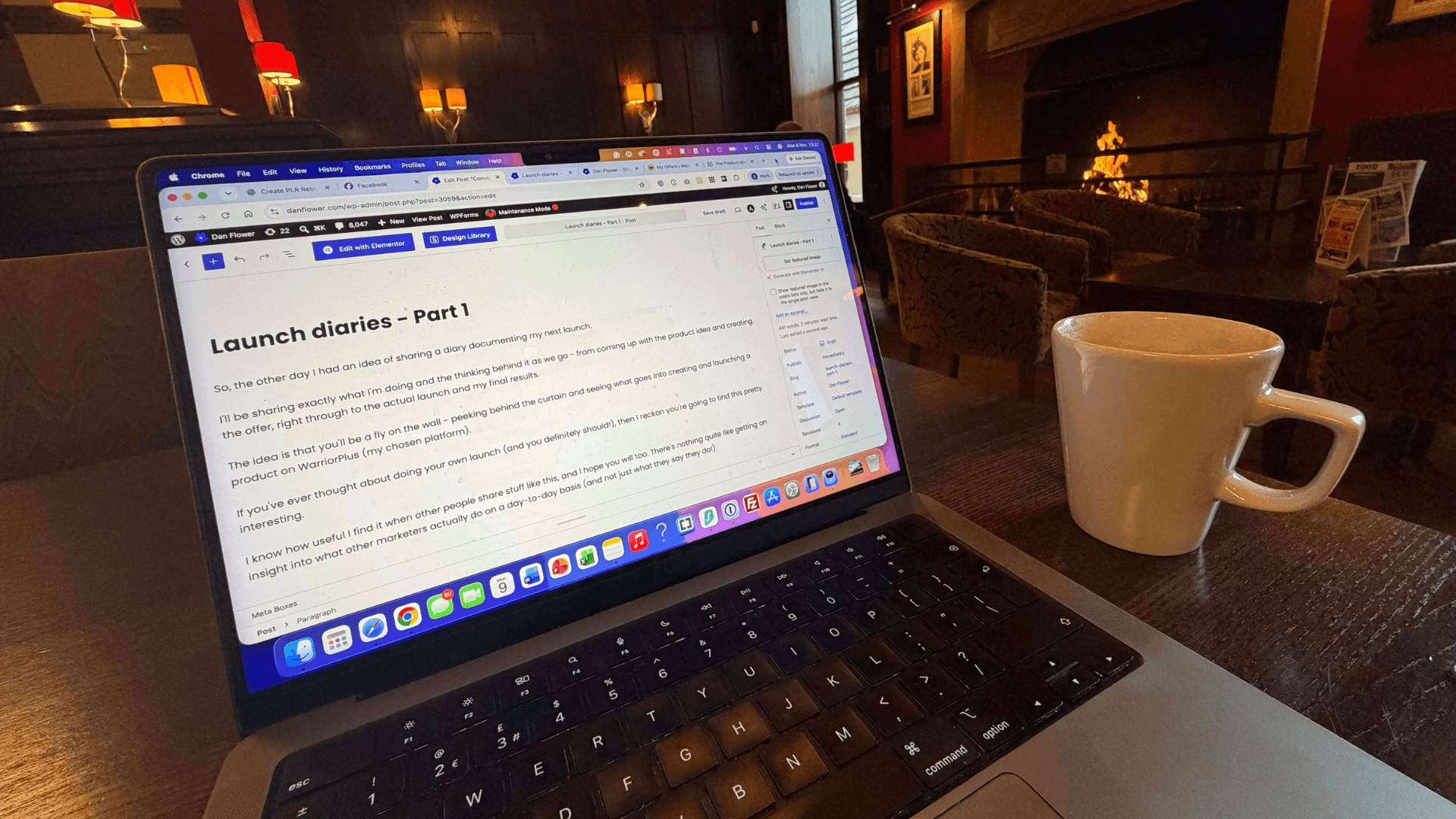
The other day I had an idea of sharing a diary documenting my next launch.
So… here it is!
I’ll be sharing exactly what I’m doing and the thinking behind it as we go – from how I come up with product ideas and create the offer, right through to the actual launch going live and my final results.
The idea is that you’ll be a fly on the wall – peeking behind the curtain and seeing what actually goes into creating and launching a product on WarriorPlus (my chosen platform).
If you’ve ever thought about doing your own launch (and you definitely should!), then I reckon you’re going to find this pretty interesting.
I know how useful I find it when other people share stuff like this, and I hope you will too. There’s nothing quite like getting an insight into what other marketers actually do on a day-to-day basis (and not just what they say they do!)
Okay, so first a bit of background information
Who am I – and what do I do?
Well, I’m an internet marketer from sunny Staffordshire in the UK. I work mainly in the PLR and MMO niches, creating and selling digital products like AI trainings and Private Label Rights (PLR) products, which are basically ready-made reports which other marketers have the right to sell themselves and/or use as source material to create their own products and offers. Some marketers also call these White Label products – but it essentially means the same thing, whichever term you choose to use.
Since starting this journey just over 2 years ago, I have launched seven products publicly on WarriorPlus – five of them in partnership with Andy Waring.
As well as this, I have launched a further 8 products internally – which basically just means I only offer them to my own list and don’t do a ‘public’ launch where I get affiliates on board to promote my product.
From all this, I have built my own email list and now have an audience of around 400 people, which is absolutely TINY… BUT my list is very responsive.
I then promote other products as an affiliate and have had quite a bit of success doing so.
In total, across all my own offers and affiliate promotions, I have generated over $27k in sales on WarriorPlus over the last 28 months. Not all of this is profit by any means, and again it’s tiny in comparison to my overall aims and ambitions, not to mention what many other marketers bring in.
But my business model works, and things will only continue to grow as I launch more products into the market and the size of my list increases.
What I’ll be doing
So, the basic idea is simple…
I will be creating a product aimed at the internet marketing niche, which is the main niche I operate in.
It will be a $5-$10 product, which will have a simple sales funnel behind it that offers buyers the chance to buy more stuff from me.
I will then recruit affiliates to promote this product for me – and I will also offer it to my own list. Those two things together are where the sales will come from.
As I only have a small list, the majority of sales will likely come from affiliates.
Each buyer will go onto my email list, where they will be offered the chance to buy more products and offers from me on an ongoing basis.
By the way, that’s the main reason for doing an affiliate-driven launch like this. The upfront profit is nice, but it’s the buyers you add to your email list that really matters, and how you build a long-term business. Each one of those subscribers can help you earn WAY more than what you bring in from the launch itself.
Why I like the launch model so much
To make money online as a digital product seller, you obviously need something to sell and an audience of people to buy it.
Now, I could create a product and then use something like digital ads to generate leads – or push paid traffic to a free offer, get them onto an email list, and then offer my product afterwards.
That business model works for some people, and it’s something I may experiment with in the future.
But my favourite model – and the one I’m going to be talking about here – is to create a paid product, get affiliates to sell it on my behalf, and then put those buyers on my email list, where I can follow up with more content and offers to buy.
I love this model because it solves the traffic problem and means I can generate sales and add buyers to my list at no upfront cost.
The affiliates drive all the traffic for me (for a commission of course), so I largely don’t need to worry about generating my own traffic, buying ads or doing social media marketing for lead generation.
I produce the offer, tell affiliates about it, and they send me clicks. In return, I offer them a commission on every sale they bring in.
It’s beautifully simple model and means I don’t have to slave away making content to generate “free” traffic or spending lots of money upfront on ads, with no guarantee of making it back.
Okay, so let’s get into it…
As a side note, I started working on this project a few days ago, so I am writing this first part retrospectively. 😊
Day 1 – Idea generation
If you’re going to do your own launch, the obvious thing to say is that you are going to have to create something to sell!
So, first we need an idea for a product.
Now, I have to admit that this is often one of the things I find most difficult about creating products.
It’s not that I can’t come up with ideas. Quite the opposite, in fact. There are so many different things I could potentially create that deciding which one to go with can be a bit of a headache!
And there’s always that nagging thought in the back of your mind…
What if I spend the next week creating something that nobody actually wants to buy?
It’s a valid concern too, especially when you’re putting a fair amount of time and effort into creating something.
Fortunately, this time around I didn’t have to spend too long thinking about it.
Because the idea for this particular product was sparked from something one of my email subscribers asked for!
A few days ago, somebody on my list got in touch and asked whether I had anything covering PLR rebranding.
As it happens, I kind of did… But it’s more a training-type product, rather than the interactive tool I suspected he was looking for.
But anyway, it got me thinking, because it was something I could immediately see the potential in, and the idea is linked to the other training product I created, which sold very well…
So I thought this could be a really hot idea to develop.
So, time to investigate this further…
Time to get ChatGPT involved!
Once I’d given the idea some thought and the idea I had to develop it further, I opened up ChatGPT.
I use AI quite extensively in my business, both for creating products and helping me work through ideas.
And I find it’s particularly useful at this early stage, when you’ve got the beginnings of an idea but haven’t quite figured out what to do with it.
So I explained what I was thinking about creating, who the product would be aimed at, and the sort of price point I had in mind.
I then used it to explore some different ways I could approach the subject.
What could the product include? What would make it useful to buyers? How could I position it so that people would immediately understand why they might want it?
I also started thinking about the potential upsells.
You see, with this particular business model, I don’t just want to sell somebody a $5 product and leave it at that.
I want to create a little funnel, where customers can buy the main product and then have the opportunity to purchase additional products that complement it.
This massively increases the potential revenue from each customer and is really the key to getting affiliates on board.
So, I wanted to make sure the initial idea had enough potential to build a small funnel around it.
And after exploring a few possibilities, I was pretty happy with what I’d come up with.
I could see a clear direction for the main product, along with some ideas for additional offers.
At this point, I felt confident enough to go ahead with it.
What if I hadn’t been given the idea?
Now, I appreciate that I was quite lucky here.
Having somebody actually ask you for a product is a pretty good starting point!
But if I hadn’t received that email, there are a few other things I would have done to come up with an idea.
For starters, I would probably have spent some time browsing the WarriorPlus marketplace.
This is something I’ve done before, and it can be a useful way to see what sorts of products are currently selling.
I wouldn’t simply copy somebody else’s product, of course, but seeing what’s popular can give you ideas for different angles or related subjects that you could explore.
Another thing I might have done is look through some of the emails and questions I’ve received from subscribers over the last few months.
Sometimes people ask questions or mention problems they’re having, and you don’t necessarily think much of it at the time.
But those little conversations can be a goldmine for product ideas.
And if you don’t have an email list yet, you can do something similar by looking through Facebook groups, forums, Reddit discussions and other places where your target audience hangs out.
What are people asking about? What are they struggling with? What do they wish they could do more easily?
Those are all potential starting points.
I’d also think about things I’ve learned or done myself recently.
For example, if I’d discovered an effective way to do something in my business, perhaps I could turn that into a short guide or training product.
In fact, several of my previous products have come about in exactly that way!
And finally, there’s always AI, which can be VERY useful for generating and exploring ideas – although I find it works best when you give it plenty of information about your audience and the sorts of problems you want to solve, rather than just asking it to come up with a load of random product ideas.
The important thing is that you don’t necessarily have to come up with something completely new or revolutionary.
You just need to find a problem that people have and create something that helps them solve it.
So, have I decided what to create?
Yes!
By the end of this first stage, I’d settled on the idea I wanted to pursue.
I also had a rough idea of what the product might look like, how I could position it, and what sort of additional offers I could potentially include in the funnel.
Nothing was set in stone at this point, but I had enough to move on to the next stage.
Now, you might be wondering what the actual product is…
Well, I’m going to keep that under wraps for the moment!
Partly because I want to take you through the process of putting everything together, and partly because I think it’ll be more interesting to reveal the finished offer a little further down the line.
But don’t worry, I will be revealing exactly what I’m creating as we go along. 🙂
What I’ve taken away from today
The main thing I’ve been reminded of is just how valuable it can be to listen to your audience.
This particular product wasn’t something I’d been planning to create.
It came about because somebody asked a question, and I realised there might be an opportunity there.
Of course, that doesn’t guarantee it’ll be a successful launch. I could put all this work in and discover that hardly anybody wants to buy it!
That’s always a possibility, and it’s one of the things that makes launching products both exciting and a little nerve-racking.
But I’ve got an idea that I believe has potential, and I’m happy enough with it to invest some time in creating the product.
And that’s really all I need at this stage.
One thing I’ve learned over the years is that you can spend forever researching and second-guessing your ideas.
At some point, you’ve just got to make a decision and get on with it.
So, Day 1 is done. I’ve got my idea, and I’m ready to start turning it into something I can actually sell.
Next up, I’ll be working out exactly what the product is going to include, how I’m going to package it, and how the rest of the funnel might look.
I’ll share what I come up with in Part 2.
See you then!